




-
Pomegranate & Rosa Mosqueta Night Balm  Best Seller
Pomegranate & Rosa Mosqueta Night Balm
Pomegranate & Rosa Mosqueta Night Balm — CoQ10 + Retinyl Palmitate + Vitamins C + E
$40.00 USD -
Liquid Rose Gold Night Serum  Best Seller
Liquid Rose Gold Night Serum
Liquid Rose Gold Night Serum — 0.3% Retinyl palmitate + 5% Tetrahexyldecyl ascorbate + Olive squalane
$90.00 USD -
Trieste Smoothing Eye Renewal Mask  Sale
SaleTrieste Smoothing Eye Renewal Mask
Trieste Smoothing Eye Renewal Mask — Hyaluronic acid + Spirulina Extract + CoQ10
Sale price $162.00 USD Regular price $180.00 USD -
L’Essenza Triestina Repair Bundle  Sale
SaleL’Essenza Triestina Repair Bundle
L’Essenza Triestina Repair Bundle — Bakuchiol 1% + Retinol + Hyaluronic Acid + Ceramides + 10% Niacinamide
Sale price $260.00 USD Regular price $305.00 USD -
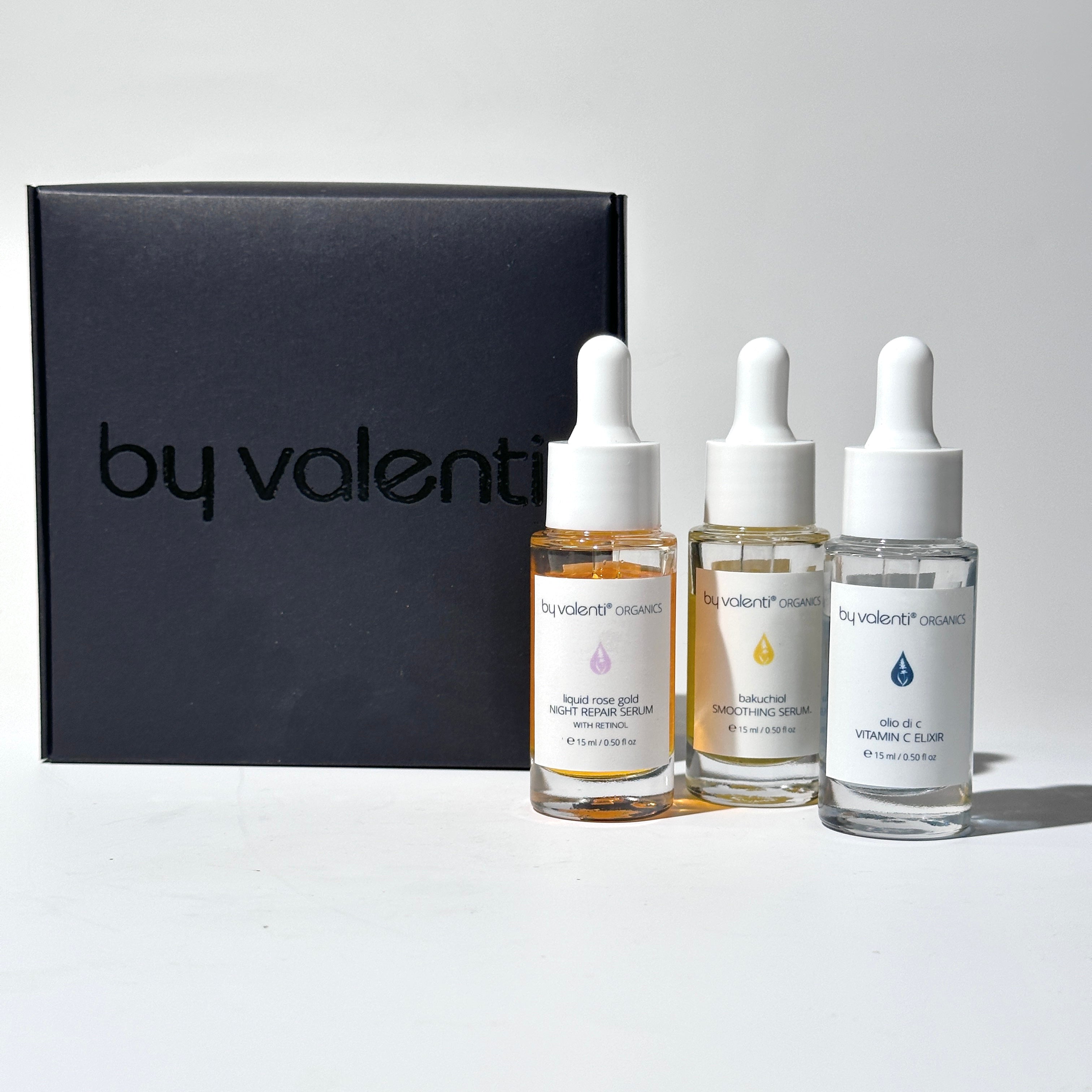
Chromatic Ritual - By Valenti Serum Collection  Sale
SaleChromatic Ritual - By Valenti Serum Collection
Chromatic Ritual - By Valenti Serum Collection — Three high-performance serums. One refined Italian ritual.
Sale price $315.00 USD Regular price $350.00 USD -
Mini Serums Gift Set  Sale
SaleMini Serums Gift Set
Mini Serums Gift Set — Bakuchiol 1% + Retinol .3% + Vitamin C 10%
Sale price $157.50 USD Regular price $175.00 USD
What Defines Retinol for Sensitive Skin
Retinol accelerates epidermal turnover and influences collagen synthesis, but its activity is frequently associated with irritation, dryness, and barrier disruption, particularly when introduced too quickly or used at higher concentrations.
In sensitive skin, the way vitamin A is delivered becomes critical. The specific form used, the rate at which it converts into retinoic acid, and the overall composition of the formulation all influence how the skin responds.
Retinyl esters, such as retinyl palmitate, undergo a multi-step enzymatic conversion in the skin before forming retinoic acid, the biologically active form of vitamin A. This gradual conversion reduces the likelihood of irritation and excessive barrier disruption while maintaining the functional role of vitamin A over time.
Retinol vs Retinyl Palmitate in Sensitive Skin
Retinol (vitamin A1) and its derivatives operate within the same biological pathway, but differ in conversion rate and tolerance.
Retinol converts more directly into its active form, resulting in faster activity but a higher probability of irritation. Retinyl palmitate, by contrast, requires additional enzymatic steps, leading to a slower, more controlled conversion and improved tolerance in sensitive or reactive skin.
This difference allows for more consistent use in individuals who do not tolerate retinol well.
Use of Retinol in Sensitive Skin
Not all skin tolerates retinol in the same way. The degree of irritation depends on the form of vitamin A used, its concentration, and the condition of the skin barrier at the time of application.
This variability in tolerance is one of the reasons behind European restrictions on retinol in skincare, which emphasize controlled use and gradual introduction.
Skin prone to reactivity, including redness, dryness, or barrier disruption, is more likely to respond poorly to rapidly converting forms of retinol. In these cases, slower-converting derivatives such as retinyl esters allow for more controlled exposure to retinoic acid.
This approach is particularly relevant for individuals introducing vitamin A for the first time, as well as for those who have previously discontinued retinol due to irritation.
Supporting Ingredients That Improve Tolerance
The response of the skin to vitamin A depends not only on the active ingredient, but on the overall formulation.
Humectants such as glycerin or hyaluronic acid help maintain water content in the stratum corneum, while lipid-compatible oils support barrier integrity. Soothing components further reduce visible signs of irritation.
Together, these elements help maintain skin function while allowing gradual epidermal renewal.
How to Introduce Retinol in Sensitive Skin
Gradual introduction remains the most effective approach. Application can begin two to three times per week, preferably on dry skin to reduce variability in penetration. Strong exfoliants should be avoided during early use, and frequency should be adjusted based on individual tolerance.
Consistency over time is more relevant than rapid escalation.
Retinyl Palmitate as a Controlled Approach to Retinol
Retinyl palmitate follows the same biological pathway as retinol, ultimately converting into retinoic acid, the active form responsible for its effects on skin renewal and collagen regulation.
The difference lies in the rate of conversion. Because retinyl palmitate requires additional enzymatic steps, its activity is expressed more gradually. This reduces the likelihood of irritation and allows the skin to adapt over time.
In this context, the objective is not to increase intensity, but to control exposure. Slower conversion enables consistent use, which is often more relevant to long-term skin function than short-term activity.
For sensitive or reactive skin, this controlled conversion allows vitamin A to be used more consistently, making retinyl palmitate a more suitable option when tolerance is a limiting factor.


