








-
Bakuchiol Smoothing Serum & Night Repair Cream Bundle  Sale
SaleBakuchiol Smoothing Serum & Night Repair Cream Bundle
Bakuchiol Smoothing Serum & Night Repair Cream Bundle — Bakuchiol 1% + Retinol + Hyaluronic Acid + Lacto Ceramides
Sale price $234.00 USD Regular price $260.00 USD -
Bakuchiol Smoothing Serum  Best Seller
Bakuchiol Smoothing Serum
Bakuchiol Smoothing Serum — Bakuchiol 1% + Buriti oil + Olive squalane
$140.00 USD -
Bakuchiol Night Repair Cream  Best Seller
Bakuchiol Night Repair Cream
Bakuchiol Night Repair Cream — Bakuchiol 1% + Retinol .3% + Hyaluronic acid + Ceramides
$120.00 USD -
Pomegranate & Rosa Mosqueta Night Balm  Best Seller
Pomegranate & Rosa Mosqueta Night Balm
Pomegranate & Rosa Mosqueta Night Balm — CoQ10 + Retinyl Palmitate + Vitamins C + E
$40.00 USD -
Aqua b3  Best Seller
Aqua b3
Aqua b3 — 10% Niacinamide Serum for Sensitive Skin
$90.00 USD -
Liquid Rose Gold Night Serum  Best Seller
Liquid Rose Gold Night Serum
Liquid Rose Gold Night Serum — 0.3% Retinyl palmitate + 5% Tetrahexyldecyl ascorbate + Olive squalane
$90.00 USD -
Olio Di C Vitamin C Serum  Best Seller
Olio Di C Vitamin C Serum
Olio Di C Vitamin C Serum — 10% Tetrahexyldecyl Ascorbate + Blue Tansy (Azulene) + Olive Squalane
$120.00 USD -
Olio di C 10% Vitamin C Elixir and Bakuchiol Smoothing Serum Set  Sale
SaleOlio di C 10% Vitamin C Elixir and Bakuchiol Smoothing Serum Set
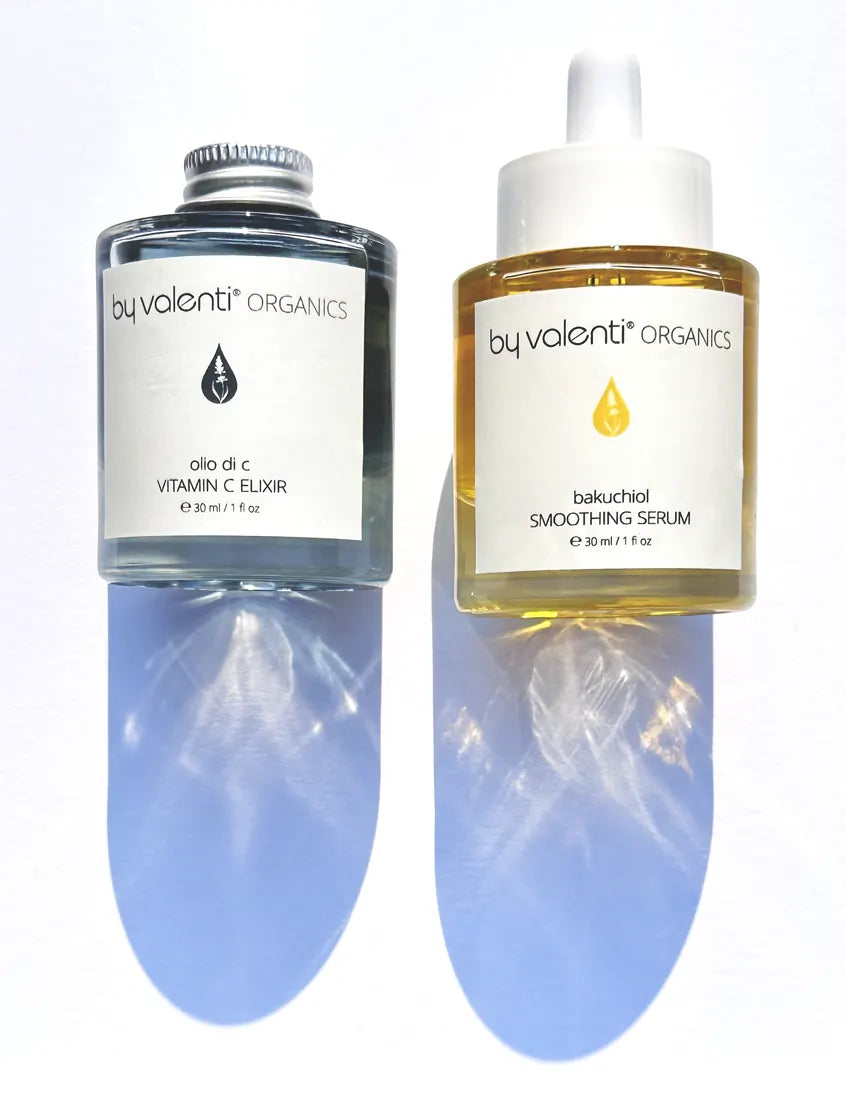
Olio di C 10% Vitamin C Elixir and Bakuchiol Smoothing Serum Set — 1% Bakuchiol + 10% Vitamin C with azulene-rich Blue Tansy
Sale price $234.00 USD Regular price $260.00 USD -
Duo Aqua B3 + Olio di C  Sale
SaleDuo Aqua B3 + Olio di C
Duo Aqua B3 + Olio di C — Niacinamide + Vitamin C. Clarifying & Brightening Duo.
Sale price $189.00 USD Regular price $210.00 USD -
Azzurrino Bi-Phase Superb Brightening Serum  New
NewAzzurrino Bi-Phase Superb Brightening Serum
Azzurrino Bi-Phase Superb Brightening Serum — Niacinamide (B3) + C + Squalane
$80.00 USD -
Trieste Smoothing Eye Renewal Mask  Sale
SaleTrieste Smoothing Eye Renewal Mask
Trieste Smoothing Eye Renewal Mask — Hyaluronic acid + Spirulina Extract + CoQ10
Sale price $162.00 USD Regular price $180.00 USD -
Mini Serums Gift Set  Sale
SaleMini Serums Gift Set
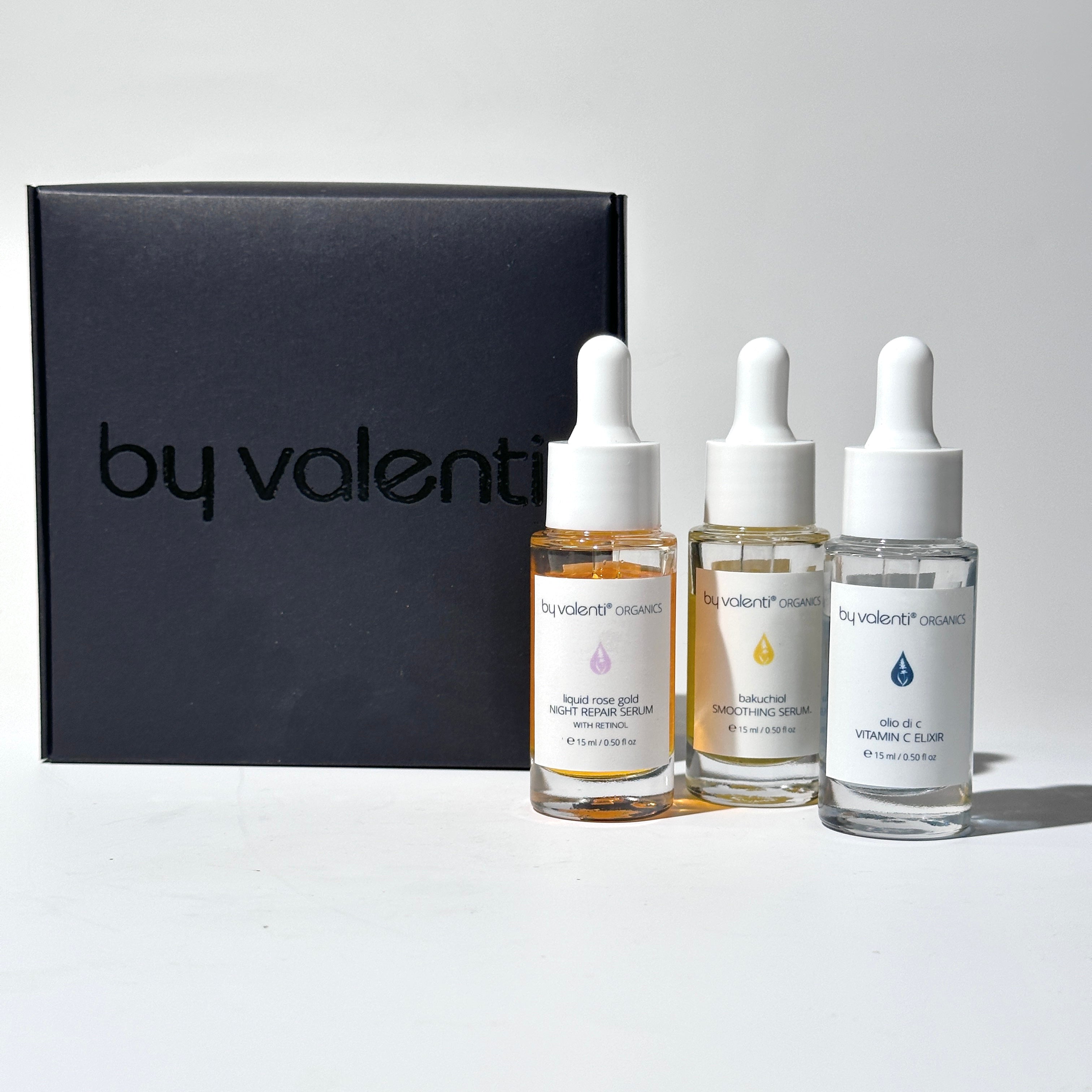
Mini Serums Gift Set — Bakuchiol 1% + Retinol .3% + Vitamin C 10%
Sale price $157.50 USD Regular price $175.00 USD
Understanding Skin Aging
Skin aging is a multifactorial process involving:
- Decreased collagen synthesis
- Elastin fragmentation
- Reduced epidermal turnover
- Oxidative stress from environmental exposure
These changes lead to visible structural decline in the skin.
One of the most consistent findings in dermatological research is the reduction in collagen production with age.
Step 1: Maintaining Barrier Function While Using Actives
Aging skin is often more reactive due to cumulative barrier stress.
Overuse of aggressive actives can:
- Increase irritation
- Disrupt barrier integrity
- Worsen texture over time
 |
 |
 |
| Gentle Cleanser for Aging and Sensitive Skin | ||
A controlled cleansing approach helps maintain tolerance while allowing actives to function effectively.
Step 2: Supporting Collagen and Skin Structure
Collagen degradation and reduced synthesis are central to wrinkle formation.
Key approach:
Stimulate skin renewal while minimizing irritation.

|
Bakuchiol has been shown to:
|
| Bakuchiol Smoothing Serum the Only Retinol Alternative |
Step 3: Antioxidant Protection and Tone Correction
Oxidative stress accelerates visible aging and contributes to uneven tone.
|
Lipid-soluble forms of Vitamin C:
Stability and formulation type are critical factors in effectiveness. |
 |
| Stable vitamin C serum for sensitive skin |
Step 4: Barrier-Supporting Hydration
Hydration influences the appearance of fine lines by improving skin surface smoothness.
 |
Niacinamide:
|
| Niacinamide serum for aging skin |
Step 5: Nighttime Repair and Lipid Support
During nighttime, skin undergoes repair processes that can be supported with appropriate formulations.

|
 |
| Night repair serum for fine lines | Lipid-rich night balm for dry aging skin |
These formulations:
- Provide lipid support
- Reduce overnight water loss
- Improve morning skin texture
Ingredient Positioning
Ingredients to Prioritize
-
Bakuchiol
Supports collagen pathways and improves visible signs of aging -
Vitamin C (stable forms)
Antioxidant protection and tone improvement -
Niacinamide
Barrier support and texture refinement -
Squalane and lipid-based emollients
Reinforce barrier and improve skin smoothness
Ingredients to Use Carefully
- High-strength exfoliating acids (risk of irritation if overused)
- Unstable forms of Vitamin C (reduced efficacy)
- Overlapping actives in the same routine
Sources
- Topical nicotinamide improves fine lines and skin barrier
Bissett, D. L., et al. “Topical Nicotinamide Provides Improvement in Various Facial Skin Appearance Parameters.” International Journal of Cosmetic Science, 2004.
https://pubmed.ncbi.nlm.nih.gov/17147561/ - Bakuchiol versus retinol clinical study
Dhaliwal, S., et al. “Prospective, Randomized, Double-Blind Assessment of Topical Bakuchiol and Retinol for Facial Photoageing.” British Journal of Dermatology, 2019.
https://pubmed.ncbi.nlm.nih.gov/29947134/ - Intrinsic aging and collagen decline in skin
Shuster, S., et al. “The Influence of Age and Sex on Skin Thickness, Skin Collagen and Density.” British Journal of Dermatology, 1975.
https://pubmed.ncbi.nlm.nih.gov/1249999/ - Mechanisms of skin aging review
Farage, M. A., et al. “Intrinsic and Extrinsic Factors in Skin Ageing: A Review.” International Journal of Cosmetic Science, 2008.
https://pubmed.ncbi.nlm.nih.gov/18489300/


